
Best Heavy-Duty Flooring for High-Traffic Commercial Areas
 Written by Steven Mac 16 November 2026 · 9 min read

By Steven Mac, Senior Flooring Technician | London Flooring Fitters™
NVQ Level 2/3 Floorcovering, CSCS cardholder and manufacturer training covering Amtico, Karndean, Polyflor and Altro. Published 16 November 2026. Technical review recommended May 2027.
A commercial floor can look perfect on installation day and become an expensive problem when it cannot cope with daily use. Rolling office chairs, grit at entrances, frequent hospital cleaning and grease in restaurant kitchens create very different demands.
The most durable flooring is not automatically the thickest or most expensive. It is the flooring system that performs safely and reliably under the actual conditions of your building.
Quick answer: Commercial LVT and heavy-contract carpet tiles are excellent starting points for offices. Specialist safety vinyl is generally more suitable for wet or greasy commercial kitchens. Homogeneous vinyl, rubber flooring and linoleum are also strong options for healthcare, education and busy circulation areas. The correct choice depends on traffic, slip risks, maintenance and the subfloor.
This guide compares six leading flooring systems, explains their technical differences and highlights the installation decisions that can determine how well your investment performs.
“The floor in a workplace must be suitable for the type of work activity taking place on it.” — Health and Safety Executive
Source: HSE workplace flooring guidance
1. What makes commercial flooring heavy-duty?
Heavy-duty commercial flooring must withstand the actual conditions of its working environment. Footfall is important, but other demands can be just as significant. A busy office and a restaurant kitchen might experience similar pedestrian movement, yet their floor-safety requirements are entirely different.
Foot traffic and concentrated wear at entrances or corridor intersections
Castor chairs, furniture, trolleys and wheeled equipment
Water, grease and other contaminants that may affect slip resistance
Cleaning chemicals, frequency and operating procedures
Moisture, movement and surface quality of the underlying subfloor
Repairability, maintenance requirements and operational disruption
The substrate, preparation system, adhesive and floor covering should be treated as one coordinated installation. An otherwise excellent material can fail if any part of this system is unsuitable.
2. Six heavy-duty commercial flooring types compared
Commercial LVT: design-led flooring for offices, retail units, hotels and receptions; needs careful substrate preparation.
Safety vinyl: specialist slip-resistant flooring for kitchens and wet areas, including systems with welded seams and coving.
Homogeneous vinyl: hard-wearing single-layer flooring suitable for many healthcare, education and circulation spaces.
Heavy-contract carpet tiles: acoustic comfort and modular replacement for busy offices.
Rubber flooring: resilient options for appropriate gyms, education and commercial walkways.
Commercial linoleum: durable systems using renewable raw materials, with product-specific installation requirements.
These are typical applications, not blanket product ratings. Individual manufacturer specifications should always be checked for the intended conditions.
Unsure which flooring specification your building needs?
London Flooring Fitters™ can assess your traffic requirements, existing subfloor, cleaning routines and site access before preparing a tailored commercial flooring quotation across London, Kent, Essex and Surrey.
3. Commercial LVT: best for offices, retail and hospitality
Luxury vinyl tiles offer the appearance of natural timber or stone with the practical benefits of a resilient floor covering. Commercial ranges from Amtico and Karndean provide realistic finishes for customer-facing buildings.
Which LVT wear layer is suitable for heavy use?
The wear layer is the clear protective material above the decorative design. It matters, but thickness alone cannot guarantee durability. For example, selected Amtico Spacia products have a 0.55 mm wear layer, while Amtico Form includes products with a 0.70 mm wear layer. These are real manufacturer examples, not mandatory commercial thresholds.
Also check the declared use classification, indentation performance, castor chair suitability, surface finish and maintenance guidance. A thicker overall plank does not necessarily mean a more durable commercial floor.
Advantages: realistic designs, straightforward daily cleaning, strong appearance and possible individual tile replacement.
Limitations: standard commercial LVT may not suit persistent greasy contamination, and poor moisture or preparation conditions can cause failure.

Explore our professional LVT installation services
4. Safety vinyl: best for commercial kitchens and wet areas

Commercial kitchens face water, grease, food spillages and frequent cleaning. Flooring should therefore be selected against the actual slip hazards expected, not merely on appearance or a general claim of being non-slip.
Altro Stronghold 30 is a specialist example. Altro publishes a nominal 3 mm thickness, a wet pendulum test value of at least 55 and an R12 classification. These are specific to this product, not all Altro or safety flooring.
Appropriately designed safety vinyl installations may use welded seams, coving from floor to wall and carefully detailed junctions around drainage or equipment. Such details can support hygienic cleaning, but the correct cleaning regime remains essential to control grease and contaminants.
Expert recommendation: Match the flooring's tested slip resistance to the likely contaminants and the site's risk assessment. A texture that performs well in one environment may not be appropriate everywhere.
View official Altro Stronghold 30 information
5. Homogeneous vinyl: best for healthcare and busy corridors

Homogeneous vinyl has a single-layer construction and is commonly specified for demanding institutional interiors. Manufacturers such as Polyflor supply homogeneous products for healthcare and education, alongside specialist safety vinyl ranges.
Its benefits can include practical cleaning, hard-wearing construction and suitable options for large corridors. In hospitals, however, specification must also consider beds, wheelchairs, trolleys, hygiene detailing, surface transitions and cleaning procedures.
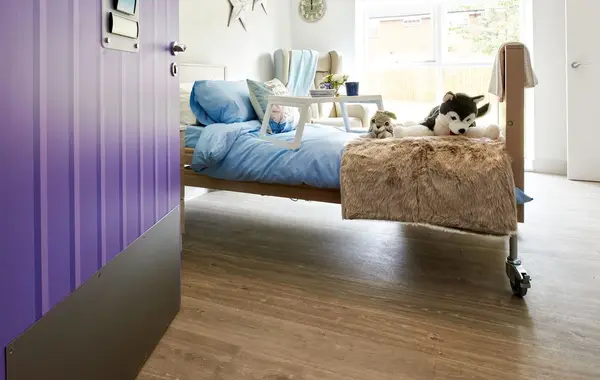
The pictured Polysafe Verona is a safety vinyl example, not a homogeneous vinyl product. It illustrates the different resilient-flooring systems that may be selected for healthcare environments.
Homogeneous vinyl is not automatically better than decorative commercial LVT. The choice depends on the building's operational priorities and the individual product's documented performance.
6. Heavy-contract carpet tiles: best for commercial offices

Commercial carpet tiles are practical for occupied offices because individual damaged modules can often be removed and replaced. Their textile surface also provides acoustic comfort in shared workplaces.
As one manufacturer example, Interface Transformation is classified EN 1307 Class 33 Heavy Contract and provides published information on continuous castor chair use. This classification relates to that range, not every Interface carpet tile.
Choose a product rated for the relevant traffic, plan maintenance and retain spare tiles from the original installation. Replacement modules may initially appear newer than surrounding flooring.
Carpet tiles are generally less suited to areas that remain wet or suffer persistent grease contamination. Those locations require a different assessment.
Find out about commercial carpet tile installation
7. Rubber flooring and commercial linoleum
Commercial rubber flooring
Rubber flooring can provide resilience, comfort and impact tolerance in suitable gyms, schools and circulation spaces. Products vary substantially, however: a gym tile designed for dropped weights is not automatically suitable for healthcare trolleys or every cleaning chemical.
Commercial linoleum
Modern linoleum remains a credible commercial option. Forbo Marmoleum uses materials including linseed oil, wood flour and rosin and offers products for education, healthcare and offices. It can be durable when correctly specified, but preparation, adhesive and maintenance instructions differ from vinyl.
Read Forbo's Marmoleum product guidance
8. Which flooring is best for your building?
Corporate offices: compare heavy-contract carpet tiles with commercial LVT, considering chairs, acoustics and appearance.
Hotels: select suitable decorative resilient flooring for receptions and public areas; specify working kitchens separately.
Healthcare: focus on cleaning, hygiene junctions, wheeled equipment, mobility and visual transitions.
Schools: consider vinyl, rubber and linoleum according to corridor traffic and day-to-day activities.
Retail: balance wear and presentation, with appropriate matting at entrances to intercept grit and moisture.
Commercial kitchens: assess contamination and slip risks before selecting specialist safety flooring.
Different parts of the same building may require different products. A single material rarely performs equally well in every entrance, office, kitchen and washroom.
9. Why heavy-duty commercial flooring fails
Even an expensive floor covering can deteriorate prematurely over a damp, uneven or unstable substrate. Common causes include residual moisture, contamination, weak screeds, inappropriate primers, adhesive incompatibility and movement.
Moisture and preparation
Moisture testing should follow the substrate and selected manufacturer's requirements. For certain glued-down Altro safety vinyl installations over concrete, the manufacturer's guidance specifies a maximum of 75% relative humidity unless appropriate moisture protection is provided. This value is not a universal limit for every flooring system.
Preparation may involve removing unsuitable old coverings, mechanical treatment, moisture testing, primers, smoothing compounds, a damp-proof membrane or appropriate plywood. A survey is needed to choose the correct method.
British Standards and professional installation
BS 8203:2017 provides a code of practice for resilient floor coverings. BS 5325:2021 covers textile flooring, including carpets and carpet tiles. These recognised British Standards are technical codes of practice, not standalone legislation. Follow applicable guidance alongside each manufacturer's instructions.
BSI: Installation of resilient floor coverings
BSI: Installation of textile floor coverings
Explore professional subfloor preparation
10. What affects the cost of heavy-duty commercial flooring?
Commercial flooring quotations depend on material specification, installation area, uplift, moisture and subfloor preparation, coving or welding, access, waste removal and any phased or out-of-hours programme.
Two buildings with the same floor area can have very different needs. Compare quotations on the complete scope rather than the initial floor-covering price alone. A measured, itemised quotation following a site survey offers a more reliable basis for budgeting.
11. Can commercial flooring be replaced without closing a building?
Often, yes. Evening, weekend and phased working can help occupied offices, shops and hotels remain operational. Nevertheless, some areas may need temporary closure for uplift, preparation, adhesive curing or safe access.
The programme should consider manufacturer's restrictions, material delivery, dust, noise, pedestrian routes and the customer's operations. Rushing a floor into service before the system is ready can undermine quality.
12. Why an experienced commercial flooring contractor matters
London Flooring Fitters™ installs LVT, carpet tiles, safety vinyl, rubber and sheet flooring throughout London, Kent, Essex and Surrey. Our work includes assessments, product selection, preparation, installation and handover.
Steven Mac holds NVQ Level 2/3 flooring qualifications, a CSCS card and training covering Amtico, Karndean, Polyflor and Altro systems. Our portfolio includes commercial environments associated with Marriott Hotels, Kingston University and BUPA Cromwell Hospital. These references do not imply that identical specifications were installed at each location.
Our practical recommendation is to inspect the subfloor and understand how the space operates before deciding on the finished-floor product. This can identify avoidable specification problems before materials are ordered.
13. Final verdict: the most durable commercial flooring
There is no universal winner. Commercial LVT and heavy-contract carpet tiles frequently suit offices; specialist safety vinyl is often a better choice for wet and greasy kitchens; and homogeneous vinyl, rubber or linoleum may suit healthcare and education.
Long-term performance depends on a complete, compatible system: a suitable floor covering, sound substrate, correct adhesives and a practical cleaning regime. Choose what suits the building, rather than simply the thickest product.
Need expert heavy-duty commercial flooring advice?
London Flooring Fitters™ provides commercial site surveys, flooring specification advice, subfloor preparation and tailored quotations for offices, hotels, restaurants, schools, healthcare and retail premises.
Frequently asked questions
What is the hardest-wearing commercial flooring?
Homogeneous vinyl, specialist safety vinyl, rubber and correctly specified commercial LVT are durable options. The best selection depends on loads, cleaning, moisture and slip risks.
Is 0.55 mm LVT suitable for heavy commercial traffic?
Some LVT products with a 0.55 mm wear layer are designed for commercial use. Check the complete classification, indentation and castor chair performance for the intended area.
Is 0.70 mm LVT better than 0.55 mm?
A thicker wear layer may provide additional wear material, but surface treatment, construction and product classification also affect performance. Neither figure is a universal guarantee.
What flooring is best for a busy commercial kitchen?
Specialist safety vinyl designed for wet and greasy conditions is often suitable. Drainage, coving, welded seams, cleaning and the site's slip-risk assessment must also be considered.
Can carpet tiles handle busy offices?
Yes, when they are specified for the appropriate commercial traffic. Modular tiles may also make localized replacement easier.
Why does commercial vinyl flooring lift or bubble?
Possible causes include excessive moisture, contaminated or unstable substrates, inappropriate adhesives and poor installation conditions. Investigate the underlying cause before replacement.
Related articles you may also like
Can You Replace Office Carpet Tiles Without Moving Desks or Closing the Office?
What Is the Best Flooring for Commercial Kitchens and Restaurants?
What Are the CQC Flooring Requirements for Care Homes?
Further reading and technical sources
HSE: Workplace floor suitability
Altro: Safety flooring installation guidance
Interface: Commercial carpet tile maintenance
Need Heavy-Duty Commercial Flooring That Lasts?
Choosing the right flooring is essential for busy commercial environments. At London Flooring Fitters™, we specialise in durable, professional flooring solutions designed around your building's foot traffic, safety requirements and daily operations.
From offices and hotels to healthcare facilities, schools and commercial kitchens, we provide expert advice, subfloor preparation and high-quality installation.
Why choose London Flooring Fitters™?
NVQ-qualified, experienced flooring specialists
Amtico, Karndean, Polyflor and Altro installation expertise
Professional site surveys and tailored quotations
Evening, weekend and phased installations available
1-year commercial workmanship guarantee, subject to terms
Covering London, Kent, Essex and Surrey
Get the right flooring specification from the start.
Request Your Free Commercial Flooring Survey & Quotation
London Flooring Fitters™ | Professional Commercial Flooring Contractors
 Can You Replace Office Carpet Tiles Without Moving Desks or Closing the Office? A Complete UK Guide
 What Is the Best Flooring for Commercial Kitchens and Restaurants? A UK Guide
 What Are the CQC Flooring Requirements for Care Homes? A Complete UK Guide
